How Chords Move
In the last lesson, you learned how to build chords. But knowing how to build a chord is only half the story. The real magic of harmony lies in how chords move from one to the next.
A chord by itself is a color. A chord progression is a painting. A single C major chord held indefinitely sounds pleasant enough, but it does not tell a story. It is only when that chord moves to another, and then another, and perhaps back home, that music begins to unfold.
If music is a story, the I chord is home, the IV chord is the journey, and the V chord is the moment just before you walk through the door again.
The Primary Triads: I, IV, and V
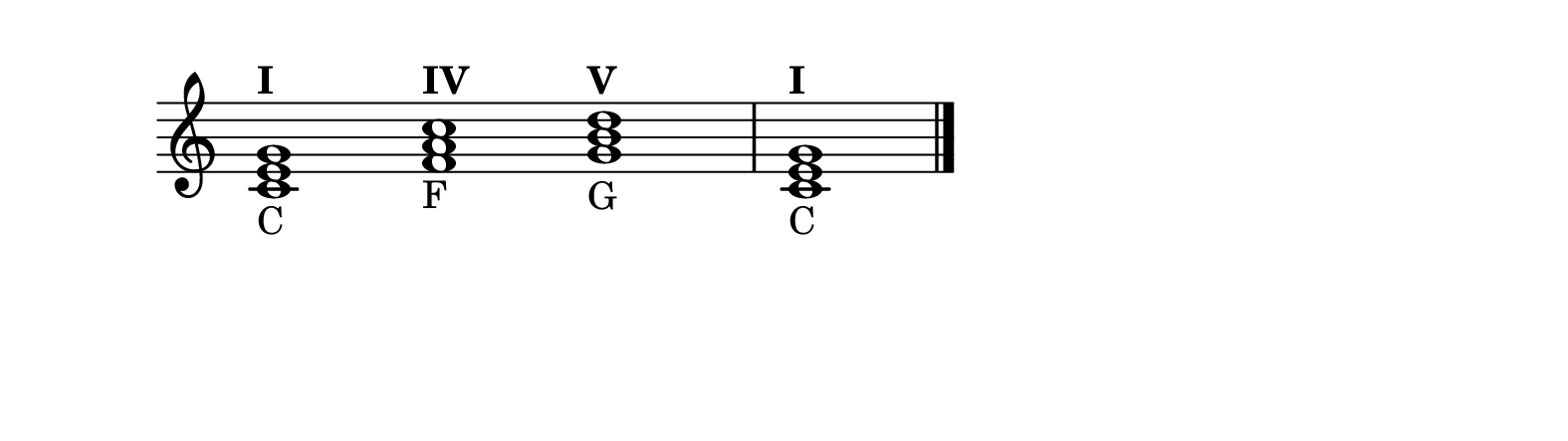
In any major key, three chords are considered primary triads: the I chord (tonic), the IV chord (subdominant), and the V chord (dominant). These three are all major, and together they contain every note of the scale.
Each has a distinct role. The I chord is home,where tension resolves. The V chord creates the greatest pull back toward home. The IV chord provides motion and departure without the urgency of V. Together, these three functions,rest, departure, and tension,create the fundamental drama of tonal music.
In the key of C major: I = C major, IV = F major, V = G major. You already played this progression in the last lesson.
The I–V–vi–IV: The Pop Progression
If there is one progression that defines modern popular music, it is I–V–vi–IV. In C major, that is C–G–Am–F. You have heard it in hundreds of songs across every genre,pop, rock, country, and beyond.
The reason it works so well is that it balances major and minor beautifully. The I and V chords feel bright and open, the vi chord introduces a touch of melancholy, and the IV chord provides a warm landing before the cycle repeats.
Try It: The Pop Progression
Play C–G–Am–F with your left hand, four beats each. Loop it several times. You will recognize the sound immediately.
The ii–V–I: The Jazz Progression
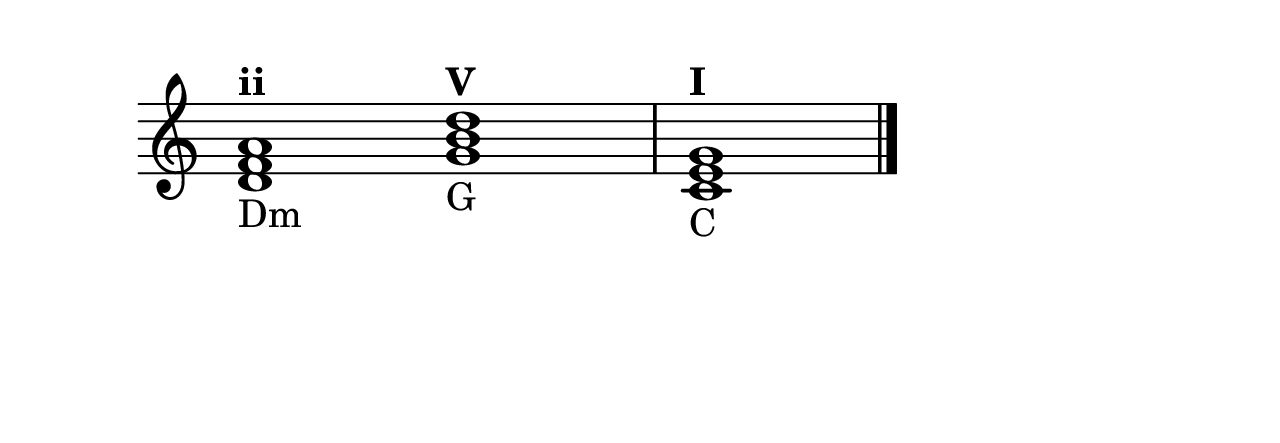
If I–IV–V–I is the sound of folk and rock, ii–V–I is the sound of jazz. In C major, that is Dm–G–C. This progression creates a sense of elegant forward motion, each chord leading inevitably to the next.
The ii chord (D minor) acts as a gentle departure. The V chord (G major) builds tension. And the I chord (C major) resolves it. Jazz musicians use this three-chord pattern as the backbone of countless standards.
The Circle of Fifths
The circle of fifths is a visual map of all twelve musical keys, arranged so that each key is a fifth apart from its neighbors. Moving clockwise adds one sharp; moving counterclockwise adds one flat.
Beyond key signatures, the circle reveals something deeper: chords that are close together on the circle sound good together. The I, IV, and V chords in any key are always neighbors on the circle. This is not a coincidence,it is the geometry of harmony.
Exercise: Transpose a Progression
Play the I–IV–V–I progression in three different keys: C major (C–F–G–C), G major (G–C–D–G), and F major (F–B♭–C–F). Notice how the feeling of the progression stays the same even as the notes change.
A chord by itself is a color. A chord progression is a painting. Now you are learning to paint.